Currently Empty: $0.00

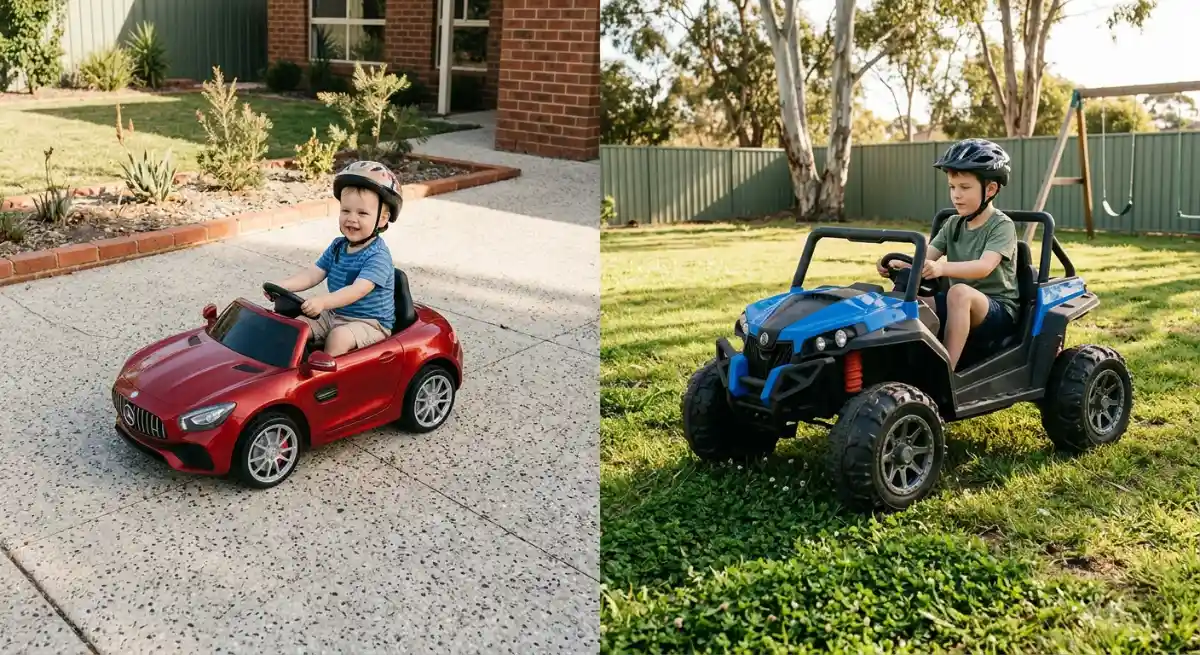
Standing in front of two nearly-identical looking ride-on cars, price tags $150 apart and absolutely no idea why one has double the number on the box – that’s where most Sydney parents end up when they start comparing a 12V vs 24V ride on car. It looks like a small detail. Get it wrong and you’ve either got a toddler who can’t reach the pedal properly or a five-year old who is bored stiff within a month because the thing barely moves faster than a walk.
So let’s discuss out on the 12V vs 24V ride on car question properly.
Table of Contents
The Quick Answer (If You’re in a Rush)
If your child is roughly 3 to 5 years old, sticking mostly to the driveway or a flat backyard, go with 12V. If they’re closer to 5 to 8 years old and you’ve got grass, gentle slopes or a bit more space to play with, go with 24V. That’s the short version. Everything below explains why and where the exceptions are.
12V vs 24V Ride On Car: What’s Actually Different?

Voltage is simply a measure of how much electrical push the battery sends to the motor. More voltage means more power going to the wheels, which translates into more speed and more torque (the strength to keep moving over bumpy ground or a slight incline).
A 12V ride-on car typically tops out around 3 to 5 km/h roughly a brisk adult walking pace. It’s gentle, predictable and nearly impossible to get into real trouble with. A 24V ride-on car on the other hand, can push 6 to 8 km/h or more depending on the model, which is noticeably faster and comes with real torque for tackling grass, dirt or a gentle slope without stalling out.
Neither one is better in general. The right choice entirely depends on the kid sitting in the driver’s seat.
Speed and Power: How Much Faster Is 24V, Really?
In practical terms, a 24V model isn’t just a bit faster – it can be close to double the top speed of a 12V. For a three-year old who is never driven anything before, that’s a genuinely overwhelming amount of speed and far too much vehicle to safely control. For an eight-year old who’s already outgrown their old 12V runabout, that same speed is exactly what makes it fun again.
Torque matters here too. A 12V motor can really struggle on grass or a slight incline – you will often see the wheels spin without much happening. A 24V motor pushes through that resistance far more easily, which is one of the biggest reasons families with proper backyards tend to upgrade.
12V vs 24V Ride On Car: The Quick Side-by-Side
Before we go deeper, here’s the whole 12V vs 24V ride on car comparison in one quick scan, so you can see exactly where the two part ways:
| 12V Ride-On Car | 24V Ride-On Car | |
|---|---|---|
| Typical age | 3 to 5 years | 5 to 8 years |
| Top speed | 3 to 5 km/h | 6 to 8+ km/h |
| Best terrain | Driveway, pavement, flat courtyard | Grass, dirt, gentle slopes |
| Torque | Lower – can struggle on soft ground | Higher – pushes through resistance |
| Price point | Generally lower | Generally higher |
| Weight capacity | Lower | Higher |
Keep this table in mind as we go through each factor properly below because a couple of these rows matter a lot more than the others depending on your specific situation.
Age and Size: Which One Actually Fits Your Child Right Now?

This is where most of the 12V vs 24V ride on car decision really comes down to. It’s less about what looks cooler in the catalogue photo and more about physically matching the vehicle to the kid.
- Ages 2 to 4, under roughly 18kg: 12V is almost always the right call. Slower speed, easier to stop and far less intimidating for a first-time driver.
- Ages 5 to 8, heavier or taller kids: 24V vehicles are usually bigger and sturdier too, built to actually hold a bigger child’s weight without the motor struggling.
- In-between kids (around 4 to 5): This is the trickiest bracket. A 12V with an adjustable speed control is often the safer bridge option rather than jumping straight to 24V.
If you’re not sure exactly where your child sits, our full kids electric cars buying guide breaks this down with a complete voltage cheat sheet and our dedicated post on choosing the right voltage and speed for a kids’ ride-on toy goes even deeper into age brackets and terrain.
Terrain: Driveway Cruiser or Backyard Beast?
Here’s a question that trips a lot of parents up: it’s not just about your kid’s age, it’s about your actual backyard.
If your child mostly drives on a flat driveway, a paved courtyard or inside the garage on rainy days, a 12V ride-on will handle that beautifully and safely. But if you’ve got a grassy backyard, a bit of a slope or loose dirt and gravel, a 12V will genuinely struggle – you will hear the motor whine and watch the wheels spin without much forward progress. That’s a 24V job, every time.
Price and Running Costs
Generally, 12V ride-on cars sit at a lower price point than their 24V counterparts, and that gap makes sense – bigger motors, bigger batteries and sturdier frames all cost more to build. Replacement parts follow the same pattern – a 24V battery or motor typically costs more to replace than a 12V equivalent, something worth factoring in if you’re buying on a tight budget for a child who might outgrow the vehicle in a year or two anyway.
Battery Life and Charging
Both 12V and 24V ride-on cars generally offer somewhere between 1 and 2 hours of continuous drive time on a full charge, which is more than enough for an afternoon at the park or a good cruise up and down the street. The real difference is how hard the battery is working – a 24V battery pushing a heavier vehicle over grass will typically need recharging a little more often than a 12V cruising gently on pavement. Either way, the golden rule stays the same: plug it in overnight so it’s ready for the next adventure.
A Real Example: Why One Sydney Family Upgraded from 12V to 24V
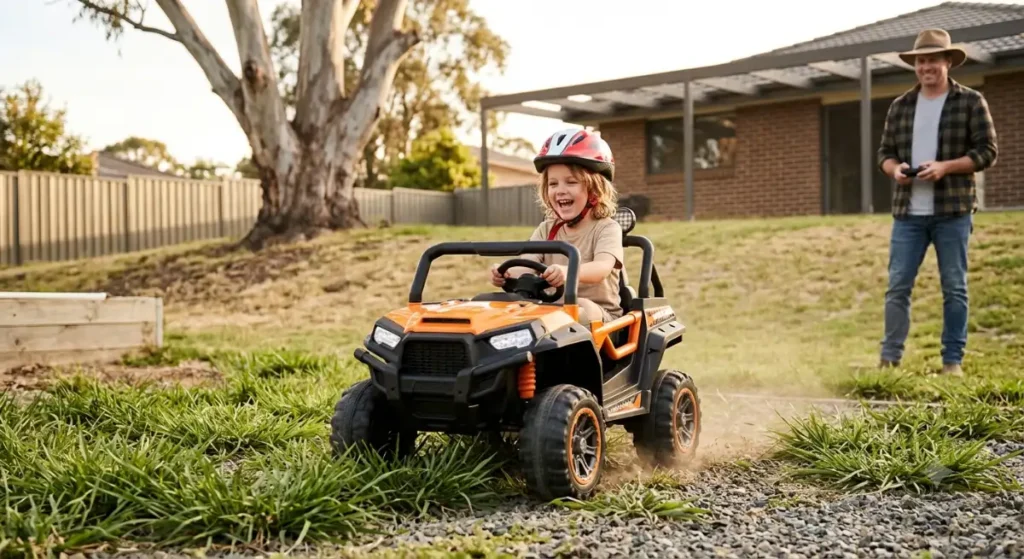
A dad from out near Parramatta came in a while back with a familiar story. His son had absolutely loved his little 12V car for two years – but had recently started complaining it felt boring and ‘too slow.’ At the same time, he had gotten too tall for it.
We walked him through a 24V model built for the 5 to 8 bracket, with a proper adjustable speed control so he could still start slow and build up. A couple of weeks later, the dad sent through a photo – his son grinning from ear to ear, dirt on his shoes, parked halfway up the little slope at the back of their yard – somewhere the old 12V would never have made it. That grin is really the whole point of getting the voltage right in the first place.
It’s worth saying too: that old 12V car wasn’t a bad purchase. It did exactly its job for two years straight, which is honestly a brilliant run for any kids’ toy. The upgrade wasn’t about the first choice being wrong – it was simply about recognising when a growing kid had outgrown it and that the 12V vs 24V ride on car decision isn’t a one-time thing. For a lot of families, it’s actually two purchases over the years, not one.
Maintenance and Longevity
One thing that rarely gets mentioned in the 12V vs 24V ride on car conversation is upkeep. Both types need the same basic care – keeping the battery charged (not left flat for months), wiping down the frame after muddy backyard sessions and checking the wheels and steering linkage every so often for wear. Where they differ slightly is load: a 24V model working harder on rougher ground will generally show wear on tyres and motors a touch sooner than a 12V gliding along a smooth driveway. Neither is high-maintenance by any stretch, but it’s worth knowing before you commit to either one.
Safety Considerations for Both
Regardless of whether you land on 12V or 24V, a few safety basics apply across the board. According to the NSW Government’s guide to children’s products and toy safety, parents should always check a ride-on is labelled for the correct age, has a working seatbelt where fitted and is used under supervision – a rule that matters even more with the extra speed a 24V model brings. Kidsafe NSW also recommends choosing a flat, enclosed area away from driveways and roads for any ride-on toy, which becomes especially important once you’ve stepped up to the extra speed and torque of a 24V.
A few quick rules we tell every parent at our Merrylands store:
- Always start a 24V model on its lowest speed setting for the first few drives
- Keep ride-on cars away from driveways, roads and pools
- Check tyres, brakes and the battery compartment regularly
- Supervise, every time, regardless of voltage
If you want the full rundown, our safety checklist for buying ride-on toys and ride-on toy safety tips for Australian parents cover everything from seatbelts to battery care in more detail.
So 12V or 24V? Our Verdict
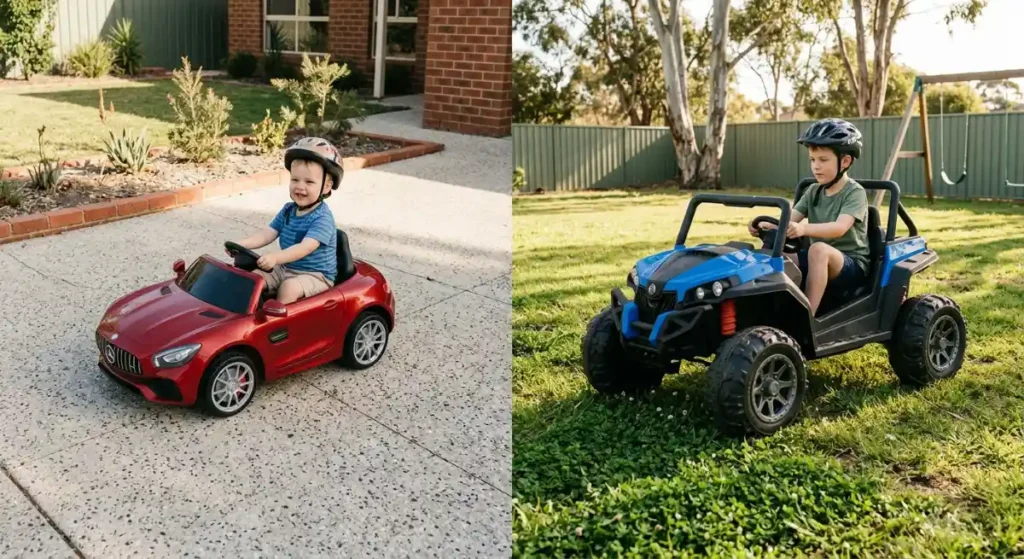
If we had to compare the entire 12V vs 24V ride on car debate down to one sentence, it is this: buy for the kid you have right now, not the kid you wish was a bit older or a bit younger. A 12V that’s genuinely enjoyed for two solid years beats a 24V that sits half-used in the shed because it was always a bit too much vehicle.
If you’re still torn, our team at Dreamland For Kids in Merrylands can talk you through your exact backyard, your child’s age and size, and point you toward the right model rather than just the one on special that week. You can also browse our full range of electric ride-on cars to compare 12V and 24V options side by side, including spare 24V batteries if you’re upgrading an existing ride.
Frequently Asked Questions
1. What’s the actual difference in a 12V vs 24V ride on car?
Voltage determines how much power reaches the motor. A 12V car is slower and gentler, suited to younger kids, while a 24V car is faster and has more torque, suited to older or heavier kids and rougher terrain.
2. What age is a 12V ride-on car best for?
12V ride-on cars generally suit children aged 3 to 5, offering a gentle walking-pace speed that’s easy to control and stop safely.
3. What age is a 24V ride-on car best for?
24V ride-on cars generally suit children aged 5 to 8, who are bigger, heavier and ready for more speed and power, especially on grass or uneven ground.
4. Can a 24V ride-on car go on grass?
Yes, far better than a 12V. The extra torque in a 24V motor handles grass, dirt and gentle slopes much more easily without stalling.
5. How long does a 12V or 24V ride-on car battery last per charge?
Most 12V and 24V ride-on cars offer roughly 1 to 2 hours of continuous drive time per full charge, depending on terrain and how hard the motor is working.
6. Is a 24V ride-on car more expensive to run than a 12V?
Generally yes. 24V vehicles and their replacement batteries or motors typically cost more than 12V equivalents, due to the larger components involved.
7. My child is right in between – should I choose 12V or 24V?
For kids around 4 to 5 years old, a 12V with adjustable speed settings is often the safer bridge option rather than jumping straight to a faster 24V model.
8. Where can I buy 12V and 24V ride-on cars in Sydney?
Dreamland For Kids, based in Merrylands NSW, stocks a wide range of 12V and 24V ride-on cars, buggies and spare batteries, with in-store advice on which voltage suits your child.