Currently Empty: $0.00

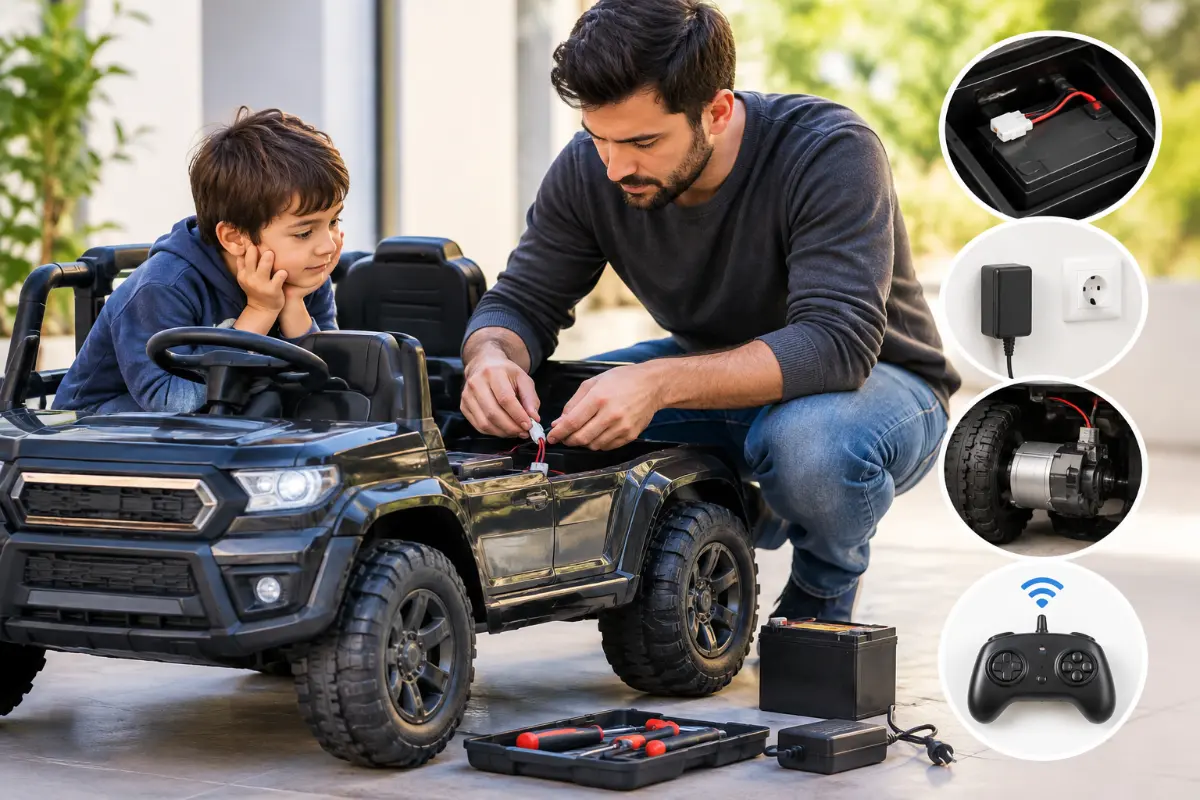
Click. Then… nothing.
Your little driver is buckled in, sunnies on, foot hovering over the pedal and the car just sits there like it’s having a nap. If your kids electric car not working has turned a sunny Saturday into a full-blown meltdown, take a deep breath. In most cases it’s a loose plug, a flat battery or a tired fuse, not a dead car. And most of those fixes take about ten minutes and cost nothing.
We’re Dreamland For Kids, a family-run ride on toy shop in Merrylands, NSW and we’ve heard this exact story from Sydney parents more times than we can count. So we’ve put together the seven fixes we’d try first, in the order we would try them: easiest first, scariest last. Grab a cuppa, grab a screwdriver and let’s get that little face smiling again.
Table of Contents
First, Three Safety Rules (Please Don’t Skip These)

Before you poke around inside anything, run through these quickly. They keep you and your kids safe and they keep a small problem from turning into a big one.
- Switch it off and unplug the battery before touching any wires or opening any panels.
- Keep kids well away while you’re working. Curious little hands and loose wires don’t mix.
- Check your warranty first. If the car is still covered, opening it up yourself can sometimes cause problems with a claim, so have a quick look at the paperwork or ring the shop you bought it from.
If a fix below asks you to do something you’re not comfortable with, stop there. There’s no shame in handing the job to someone who does it every day.
Kids Electric Car Not Working? Start With the 60 Second Check
Different problems show up in different ways, so before you dive in, match what you’re seeing to the likely cause. This little table will save you a lot of guessing.
| What’s happening | Most likely cause | Start at |
| Nothing at all, no lights, no sound | Loose battery plug, flat battery or blown fuse | Fix 1, 2 and 4 |
| Ride on car won’t move but you hear a click or hum | Pedal switch, motor or gearbox | Fix 5 and 6 |
| Ride on car not charging | Charger, charging port or battery | Fix 2 and 3 |
| Moves a bit, then cuts out | Overheated fuse, weak battery or overloaded motor | Fix 2 and 4 |
| Grinding or clicking noise | Gearbox or something jammed in the wheel | Fix 6 |
| Car works but remote doesn’t | Remote batteries or pairing | Fix 7 |
Found your symptom? Jump to that fix. Not sure? Just start at Fix 1 and work down.
Fix 1: Check the Battery Plug (The Most Common Culprit)
If your kids electric car not working shows no signs of life at all and the ride on car won’t move, this is where we’d start, because it’s the most common cause by far.
Inside most ride-on cars, the battery connects to the car through a plastic plug. Bumps, bouncing over the lawn and time itself can work that plug loose. Sometimes it’s only a few millimetres out and that’s enough to cut all the power.
Here’s what to do:
- Turn the car off and find the battery (usually under the seat or in a compartment at the back).
- Look at the plug joining the battery to the car’s wiring.
- Unplug it, check for any dirt, corrosion or discolouration, then push it back in firmly until it clicks or sits fully flush.
- Try the car again.
If the plug looks melted, brown or burnt, don’t keep using it. That usually means too much current was passing through a loose connection, and the plug (and often the battery lead) needs replacing.
Fix 2: Charge the Battery Properly (Ride On Car Not Charging? Read This)
Here’s one that catches a lot of families out: a battery that’s been sitting flat for weeks, or a long winter in the shed, can behave as if it’s completely dead when it’s actually just very low.
A few simple tips:
- Use the charger that came with the car. A charger with the wrong voltage can either do nothing or damage the battery.
- Charge it for the time in your manual. Most manuals suggest around 8 to 12 hours, and warn against leaving it on for days on end.
- Look at the charger light. Many chargers show red while charging and green when done, but this varies, so check your manual for your model.
- Try a different power point. It sounds silly, but a faulty wall socket or power board is a surprisingly common reason a ride on car won’t charge.
If you’ve got a multimeter, you can check the battery directly. A healthy 12V battery should read around 12.5V or more after a full charge. If it drops well below that again within a few hours of being unplugged, the battery is probably worn out and ready for replacement.
Fix 3: Test the Charger and the Charging Port
Still stuck with a ride on car not charging, even after trying a different socket? Then it’s time to look at the charger itself and the little port it plugs into.
The charger: If the charger light never comes on at all, or the cable feels hot, cracked or loose at the plug, it’s likely the charger that’s failed rather than the battery. If you’ve got a multimeter, a working charger should show a voltage at or slightly above its rating on the label. Zero means the charger is done.
The charging port: Over time, the little socket on the car can collect dust or get bent from being plugged in at an angle. Have a good look inside with a torch. If you see anything stuck in there, gently clear it with a dry cotton bud (with the battery unplugged first). If the port is loose or wobbly, the wires behind it may have come away from the connection.
A tip from our Merrylands showroom: charge the battery on its own if your model lets you take it out. If the battery charges fine out of the car but not in it, you’ve just narrowed the problem down to the car’s charging port or wiring.
Fix 4: Check the Fuse (Your Car’s Little Bodyguard)
Nearly every ride-on car has a fuse designed to protect the motor and wiring when something draws too much power. When it trips or blows, the car stops cold, and it can look just like a dead battery.
There are two main types:
- Blade fuse: looks like a tiny coloured plastic block with two metal prongs, a bit like a car fuse. If the metal strip inside is broken or the fuse looks blackened, it’s blown and needs replacing with one of the exact same rating.
- Resettable (thermal) fuse: trips when the motor gets too hot or overloaded, then resets itself after a few minutes. If your car stops mid-drive and starts again after a short rest, this is probably what’s going on.
If a car keeps tripping its fuse, it’s telling you something. Common reasons include driving up a steep slope, carrying too much weight, running through long grass or sand, or something jamming the wheels. Easing off the workload often solves it.
One important rule: never swap in a bigger fuse or bypass it with a bit of wire. The fuse is the safety net, and removing it can melt wiring or worse.
Fix 5: Test the Pedal Switch and Wiring
If the battery’s fine, the plug’s tight and the fuse is good, but your kids electric car not working still won’t go (maybe you hear a faint click when your child presses the pedal), the pedal switch is next on the list.
The foot pedal is basically a switch that tells the car “go.” Kids’ feet are hard on them, and over time the contacts can wear or collect dirt. You can often hear a click even when nothing’s happening, and that’s the switch moving without connecting properly.
What to try:
- With the battery unplugged, find the pedal and the wires running from it.
- Check that the wires are firmly connected and none have come loose or frayed.
- Press the pedal and feel for a firm, springy click. If it feels mushy, stuck or gritty, it’s likely worn.
- Check the forward and reverse switch too. Sometimes it’s sitting half way between settings, and the car won’t move until it’s pushed firmly into one position.
Replacement pedal switches are generally inexpensive and simple to swap if you’re comfortable with basic wiring. If not, this is a quick job for a repairer.
Fix 6: Check the Motor and Gearbox
Sometimes a kids electric car not working means the motor is humming but the wheels barely turn, or the car makes a nasty grinding or clicking sound. That points to the motor or gearbox.
Start with the simple stuff. Lift the car and spin each wheel by hand. If one feels stiff or jammed, check for grass, string, pet hair or a stray sock wrapped around the axle. You’d be amazed at what we’ve heard fished out of wheel arches.
If the wheels spin freely but the car still struggles:
- Smell or feel the motor. If it’s very hot or smells burnt, stop and let it cool. A motor that overheats repeatedly may be worn out.
- Listen for grinding. A harsh grinding or ratcheting sound usually means a stripped gear in the gearbox, which is common when a car has been pushed hard over rough ground or carrying too much weight.
- Check the motor wires. Make sure the two small wires on the motor are firmly attached and not corroded.
Gearboxes and motors are among the most common wear parts, especially on higher-power models. If you’re deciding between voltages for a future upgrade, our 12V vs 24V ride on car guide explains how voltage affects motor strain and which one suits your child’s size and terrain.
Fix 7: Check the Remote and the Controller (the Motherboard)
If your kids electric car not working only happens when the parent remote is in play, or the car does nothing at all even though the battery, fuse, plug and pedal all check out, the control board (often called the motherboard) could be the culprit.
Start with the easy bits:
- Replace the batteries in the remote. It’s the most common reason a 2.4G remote stops working.
- Re-pair the remote. Many cars need the remote and car paired again after the battery has been disconnected. Check your manual for the pairing steps, which usually involve holding a button while switching the car on.
- Look for obvious damage. With the battery unplugged, check the control board for burnt marks, a burning smell, swollen parts or water damage. A board that’s been rained on or driven through puddles often fails.
If you suspect the board is fried, that’s usually the point to stop and get help. It’s a sensitive part, wiring differs between models, and a wrong connection can damage the motor too. If you’re looking for a replacement or an upgrade, you can browse our 2.4G remote control option.
Why Batteries Fail (and How to Make the Next One Last)

Honestly, the battery is behind most of the “my kids electric car not working” calls we get. Most ride-on cars use sealed lead-acid batteries, and these are a bit like phones: they don’t love being drained flat, left unused or baked in the sun.
A few habits stretch battery life a long way:
- Charge after every few uses, not just when it dies. Letting it sit flat is the number one battery killer.
- Don’t overcharge. Stick to the time in the manual.
- Store it charged. If the car’s going into the shed for winter, charge it fully first, and top it up once a month.
- Keep it out of extreme heat or cold. A battery cooking in a hot garage in January won’t last.
- Don’t overload it. Extra passengers and steep hills make the battery (and motor) work much harder.
If your battery is more than a couple of years old and won’t hold a charge, it’s probably time for a new one. If you have a higher-power ride, we stock a 24V 7AH rechargeable battery that suits many 24V models, and our team can help you work out the right match before you buy.
A Real Example: The “Dead” Car That Wasn’t
A dad from Guildford rang us last summer, convinced he needed to buy his daughter a whole new ride-on car. It had been sitting in the garage all winter, and when he tried it in spring, there was nothing: no lights, no sound, no movement. His daughter had already announced that she was “never speaking to the car again.”
We walked him through the first two fixes over the phone. The battery plug had worked loose, and the battery was almost completely flat. He pushed the plug in, charged the battery overnight, and tried again the next morning.
An hour later he sent us a photo of his daughter doing laps around the backyard, grinning like she’d won the lottery. A five-minute fix and one overnight charge saved him a few hundred dollars and, more importantly, got a very happy little driver back on the road.
When It’s Time for Ride On Car Repair in Sydney (or a Replacement)
Not every problem is a DIY job, and that’s okay. Here’s a rough guide to when it’s time to hand it over:
Call for help if:
- You smell burning or see melted plastic or scorched wiring
- The control board is damaged, wet or burnt
- You’ve worked through all seven fixes and the car still won’t go
- The car is still under warranty and you’d rather not risk voiding it
If you’re in Merrylands or anywhere around Sydney and you’re after ride on car repair advice, parts or a replacement battery, get in touch with our team at Dreamland For Kids. Tell us the model and what the car is doing, and we’ll point you in the right direction.
Consider replacing the car if:
- Your child has grown out of it (heavier kids put real strain on a small motor)
- The repair cost is close to the price of a newer model
- It’s had multiple faults, and you want something more reliable
If you’re heading down that road, our kids electric cars buying guide walks through how to choose the right one, and you can browse our full range of electric ride-on cars to compare options. For help with the power question, our post on choosing the right voltage and speed is a good place to start.
One more thing worth knowing: in Australia, products come with consumer guarantees, meaning they need to be of acceptable quality and last a reasonable time. If a car fails well before you’d expect, it’s worth asking the seller what they can do before you spend money on repairs.
Keep It Safe Once It’s Fixed
Once your little driver is back behind the wheel, a quick safety refresher is always worthwhile. The NSW Government’s guide to children’s products and toy safety is a handy read for any parent, and Kidsafe NSW has useful advice on choosing safe play spaces. A flat, fenced area away from roads, driveways and pools is the best place for a ride-on car, and supervision is a must.
For more, have a look at our safety checklist for buying ride-on toys and our guide to ride-on toy safety tips for Australian parents.
The Bottom Line
A kids electric car not working feels like the end of the world when there’s a hopeful little face staring at you, but it’s almost always fixable. Check the plug, charge the battery properly, test the charger, look at the fuse, then work through the pedal, motor and controller. Nine times out of ten, the answer is in the first few steps.
And if you get stuck, or it’s time for an upgrade, the team at Dreamland For Kids in Merrylands is always happy to help. Because the best sound in the world on a sunny Aussie weekend is a ride-on car humming down the driveway, with a very proud driver at the wheel.
Frequently Asked Questions
1. Why is my kids electric car not working at all?
The most common causes are a loose battery plug, a flat or worn-out battery, or a blown fuse. Check the plug first, then charge the battery fully, then inspect the fuse.
2. Why won’t my ride on car move even though the battery is charged?
If the battery is fine, the problem is usually the pedal switch, the fuse, the motor or the gearbox. A clicking sound when the pedal is pressed often points to a worn pedal switch.
3. Why is my ride on car not charging?
Check that you’re using the correct charger, try a different power point, and look at the charger light. If it still won’t charge, the charger, charging port or battery may need replacing.
4. How long should I charge a kids ride on car battery?
Most manuals suggest around 8 to 12 hours, and warn against leaving it plugged in for days. Always follow the instructions that came with your model.
5. How long does a ride on car battery last?
Most sealed lead-acid batteries last around one to three years with regular use and good care, depending on how often it’s used, how it’s charged and how it’s stored.
6. Can I fix a ride on car motherboard myself?
It depends on your comfort with electronics. Simple checks like remote batteries and re-pairing are easy, but a damaged control board is usually best left to a repairer, since wiring differs between models.
7. Is it worth repairing a kids electric car not working, or should I buy a new one?
If the fault is a battery, plug, fuse or switch, repairs are usually cheap and worthwhile. If the repair cost is close to a new car, or your child has outgrown it, replacing it may make more sense.
8. Where can I get ride on car repair in Sydney?
If you’re in Merrylands or greater Sydney, contact Dreamland For Kids with your car’s model and the fault you’re seeing, and the team can point you in the right direction for parts, batteries and advice.
9. What should I do if my kids electric car not working after being stored all winter?
If your kids electric car is not working after months in storage, the battery has likely undergone a deep discharge or the connection terminals have accumulated minor oxidation.
Before replacing anything, disconnect the battery plug, inspect the terminals for rust or dust, reconnect it firmly, and charge it uninterrupted for 8 to 12 hours using a working wall socket. Storing a ride-on without periodic charges is the leading cause of winter battery failure.
10. Why is my kids electric car not working even though the lights and sound still turn on?
When the dashboard lights and music work but the vehicle refuses to drive, the main battery connection and basic control board are still receiving power.
The issue is usually isolated to the drivetrain system—most commonly a faulty foot pedal switch, a disconnected wire leading to the drive motors, a loose gear shifter switch, or an engaged thermal overload fuse.
11. How can I tell if my kids electric car not working due to a blown fuse vs a dead battery?
A blown or tripped fuse usually happens instantly during heavy strain (like riding over steep hills or thick grass), cutting off all power completely and suddenly.
If your vehicle has a resettable thermal fuse, it will automatically work again after cooling down for 10 to 15 minutes. Conversely, a dead or dying battery typically gives warning signs first – such as sluggish acceleration, dimming lights, or a runtime that drops drastically before cutting out.
12. Why is my kids electric car not working on grass or hills?
Driving on steep hills or thick grass overloads the motor, causing the thermal fuse to trip and temporarily cut power to protect the vehicle.
13. Can a wet kids electric car stop working permanently?
Water can short-circuit the control board or corrode wiring. If it gets wet, unplug the battery immediately and let it dry completely before turning it back on.
14. How much does it cost to fix a kids electric car not working?
Most common fixes – like reconnecting a loose plug or replacing a simple fuse or pedal switch—cost between $0 and $15 to repair yourself.
15. Why is my kids electric car not working after being left out in the rain?
Water exposure can short-circuit the control board, corrode internal switch contacts, or trigger a safety shutdown. If caught in a downpour during ride-on car troubleshooting, disconnect the battery immediately, open the seat compartment and let all wiring and circuit boards dry completely for 24 to 48 hours before testing power again.
16. Is basic troubleshooting safe when my kids electric car is not working?
Yes, basic troubleshooting for a kids electric car not working – such as checking for loose battery plugs, testing wall chargers, replacing low-voltage fuses, or cleaning foot pedal connections – is completely safe to do at home. Most toy vehicles run on safe, low-voltage 6V, 12V, or 24V DC systems. Always remember to switch off the vehicle and disconnect the battery before inspecting internal wires.
17. Who should I contact if my kids electric car not working after trying all fixes?
If your kids electric car is not working after checking the plug, battery, charger, fuse, pedal, motor, and parent remote, contact the store where you bought it or a specialized toy repairer like Dreamland For Kids. If the car is still under warranty, reach out to the retailer or manufacturer first before attempting any advanced electronic repairs.
18. Can a faulty remote cause a kids electric car not working issue?
Yes, if the parent remote control loses pairing, has dead batteries, or has an engaged emergency stop button, it will override manual foot pedal controls and keep the vehicle stationary. If your kids electric car is not working via the remote or manual drive, check the remote batteries and re-pair the remote to the control board following your owner manual’s instructions.